Showing posts with label new knowledge fronteirs. Show all posts

Monday, June 20, 2016

Working Visit from Malaysian Institute of Integrity


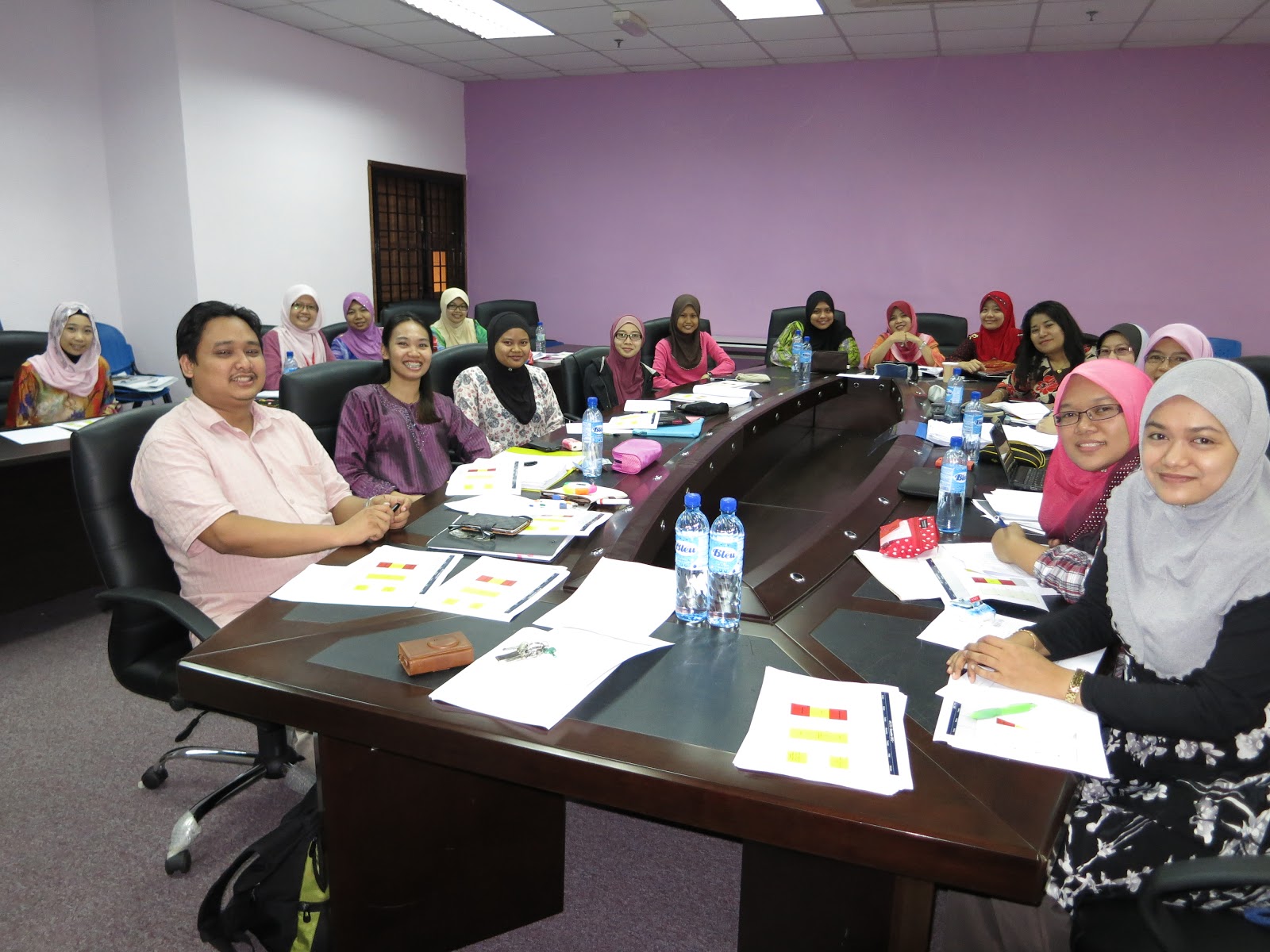
The Accounting Research Institute welcomes officers from its long-standing research and consulting collaborative partner - Malaysian Institute of Integrity (IIM) - Mr Mohd Nizam Ali, Wan Noraini and Mr Rais from the Centre for Knowledge and Consultancy on Integrity for their visit today.
IIM's role is crucial in the establishment of one of ARI's leading research cluster in Corporate Ethics and Integrity.  In 2010, researchers from ARI together with some leading researchers from Universiti Sains Malaysia (USM), International Centre for Education in Islamic Finance (INCEIF) and the Securities Industry Development Corporation (SIDC) developed a Corporate Integrity Assessment Questionnaire (CIAQ).  The Corporate Integrity System Assessment Questionnaire (CIAQ) is used to evaluate implemented Corporate Integrity Systems.  CIAQ comprises twelve important dimensions namely Vision & Goals, Infrastructure, Confidential Advice & Support,
Ethics communications, Ethics Training & Education, Disciplinary Rewards & Measure, Measurement Research & Assessment, Organisational Culture, Whistleblowing, Leadership, Legal Compliance, Policies & Rules and Corporate Social Responsibility.  During the visit today, the team discussed strategies and efforts to enhance wider implementation of CIAQ among corporate players.  The meeting further discussed the need to source research budget to support research and the digitization of CIAQ as a measure of corporate integrity at workplaces.  In the long run, CIAQ will form an important "CEO Dashboard" item in corporations.  It is expected that a strong corporate integrity culture will result in healthy capital market development. Through digitized corporate Integrity Assessment tool, corporations can analyse and measure their own integrity implementation scores.  This preventive measure will hopefully reduce corruption and financial leakages in organisations.

Tuesday, April 19, 2016

Researchable Topics in Money Laundering Control

In view of increasing trends in money laundering offences and its potential negative impacts on a country's economy, there are currently various "hot topics" that researchers can explore for their research work.  Listed below are proposed topics that can be undertaken:

  1. AML-CFT Regime in Emerging Economies: A Cross-Country Study
  2. The Proceeds of Crime: Problems of Investigation and Prosecution
  3. Dirty Money: The evolution of money laundering counter-measures.
  4. Money-Laundering in the Twenty-First Century: Risks and Countermeasures.
  5. A Comparative study on the criminalization of money laundering activity in a selected region
  6. Compliance with the AML/CFT International Standard: Lessons from a Cross-Country Analysis
  7. The Regulation of Mobile Money in Emerging Markets
  8. Assessment of  Money Laundering and Financing of Terrorism (ML/FT) Risks in non-profit organisations
  9. Customer Risk Assessment within AML/CFT Framework
  10. Due Diligent and Know Your Clients Analysis Among Designated Non-Financial Businesses and Professions
  11. Financial Action Task Force Evaluation of AML-CFT International Standards and Their Effectiveness
  12. Trade-Based Money Laundering and Financial Trail Analysis
  13. Transfer-Pricing Manipulation and Tax Evasion of MNCs in Tax Heaven Jurisdictions


9.        

Monday, April 18, 2016

Financial Action Task Force (FATF) to Mitigate Money Laundering Offences

Due to the complexities of money laundering activities and their potential negative impacts towards a country's economic growth, there are a lot of agencies being set up to monitor and mitigate money laundering offences.  At the international level, one very prominent agency is the Financial Action Task Force (FATF).  FATF is an inter-governmental body established in 1989 during the 1989 G7 Summit in Paris to combat the growing problem of money laundering. The task force was charged with studying money laundering trends, monitoring legislative, financial and law enforcement activities taken at the national and international level, reporting on compliance, and issuing recommendations and standards to combat money laundering. At the time of its creation, the organisation had 16 original members.  Today, there are 37 FATF country members (Malaysia included), 2 FATF Observers and 9 FATF Associate members (APG, CFATF, MONEYVAL, EAG, ESAAMLG, GAFILAT, GIABA, MENAFATF and GABAC. 


The objectives of the FATF are to set standards and promote effective implementation of legal, regulatory and operational measures for combating money laundering, terrorist financing and other related threats to the integrity of the international financial system.  The FATF is therefore a “policy-making body” which works to generate the necessary political will to bring about national legislative and regulatory reforms in these areas.  The FATF has developed a series of Recommendations that are recognised as the international standard for combating of money laundering and the financing of terrorism. They form the basis for a co-ordinated response to these threats to the integrity of the financial system and help ensure a level playing field.  First issued in 1990, the FATF Recommendations were revised in 1996, 2001, 2003 and most recently in 2012 to ensure that they remain up to date and relevant, and they are intended to be of universal application. The FATF monitors the progress of its members in implementing necessary measures, reviews money laundering and terrorist financing techniques and counter-measures, and promotes the adoption and implementation of appropriate measures globally.  In collaboration with other international stakeholders, the FATF works to identify national-level vulnerabilities with the aim of protecting the international financial system from misuse. There's a lot of interest among researchers to explore topics in Money laundering research.  The Accounting Research Institute (ARI) has established a dedicated research cluster to conduct research on money laundering-related issues.

Sunday, April 17, 2016

Understanding Money Laundering Offences

Money laundering constitutes a generic term used to describe a predicate crime.  A predicate offence is a crime that is a component of a more serious criminal offence. For example, generating proceed of crime through fraud or criminal-breach of trust (CBT) is the main offence and money laundering is the predicate offence when the original ill-gotten proceeds are disguised and cleansed so that such proceeds appear to have derived from a legitimate source. In Malaysia, the Second Schedule of the Anti-Money Laundering, Anti-Terrorism Financing and Proceeds of Unlawful Activities Act (AMLATFPUAA 2001) has outlined various sections and sub-sections of forty two legislations that are considered as predicate offences.  In practice almost all serious crimes, including, criminal breach of trust, drug trafficking, human trafficking, tax evasion, terrorism, fraud, robbery, prostitution, illegal gambling, arms trafficking, bribery and corruption are capable of predicating money laundering offences in most jurisdictions. 

The processes by which criminally derived proceeds (These proceeds can be in the forms of cash, assets/property, donations or investments) may be laundered are extensive. Though criminal money may be successfully laundered without the assistance of the financial sector, the reality is that hundreds of billions of dollars of criminally derived money is laundered through financial institutions, annually. The nature of the services and products offered by the financial services industry (namely managing, controlling and possessing money and property belonging to others) means that it is vulnerable to abuse by money launderers.  Today, money launderers are opting for other forms of institutions to launder their illegal proceeds.  Institutions such as non-profit organisations, co-operatives, money changers, designated non-financial businesses and professions (DNFBPs) such as accountants, lawyers, real estate agents, company secretaries, and casinos are now becoming popular targets for money laundering.

There are typically three stages of the money laundering process: Placement, Layering and Integration.  Placement is the movement of cash/fund from its original source. Often disguised, it is placed into circulation by putting it through financial institutions, casinos, shops, bureau de change and other businesses, both local and abroad. Layering is a process where monies are placed into multiple and complex transactions with the sole purpose of making it difficult for the law enforcement agencies to detect the financial trails of money laundering activities.  Integration is the movement of cleansed laundered money into the mainstream economy.  Now that the laundered money appears cleaned, money launderers will use the normal banking system to place such monies which appear to be normal business earnings. 

Tuesday, January 19, 2016

Money Laundering and Terrorism Financing are Serious International Offences

Many countries globally have legislated the offences of money laundering (ML) and terrorism financing (TF) and consider both as serious or predicate offences.  Many legislation on ML/TF provide wide-ranging investigation powers including powers for law enforcement agencies and Public Prosecutor to freeze and seize properties that are involved or suspected to be involved in money laundering or terrorism financing offences, and the power of the court to forfeit properties derived from the proceeds of serious crimes.  
Money laundering and the financing of terrorism can have devastating economic and social consequences for countries, especially those in the process of development and those with fragile financial systems. The economy, society, and ultimately the security of countries used as money-laundering platforms are all imperiled. Here are just a few examples of how illicit financial flows can affect the economy and institutions of the host country (excerpts of various sources):
  • Financial institutions that accept illegal funds cannot rely on those funds as a stable deposit base. Large amounts of laundered funds are likely to be suddenly wired out to other financial markets as part of the laundering process, threatening the institution’s liquidity and solvency. A financial institution’s reputation and integrity can be irrevocably harmed if involved in money laundering or financing terrorism.
  • Local merchants and businesses may find that they cannot compete with front companies organized to launder and conceal illicit funds. Many such front companies offer their services and goods at below-market rates and even at a loss. Because their primary objective is the laundering of money, they do not need to compete in the marketplace and make a profit for their owners.
  • Money laundering may also distort some economic sectors and create instability in their markets. Money launderers may channel funds to sectors or areas where funds are unlikely to be discovered whether or not investment is needed or real returns are offered. The often sudden departure of investments from those sectors may impair the industries involved.
  • Currencies and interest rates can be distorted by money launderers’ investment practices, based as they are upon factors other than market returns.
  • Money laundering and terrorist financing do nothing for the reputation of the host country. The loss of investor confidence that follow revelations of large-scale involvement in such activities can sharply diminish opportunities for growth. Once a country’s reputation is tarnished, it  takes years to repair.

Monday, January 18, 2016

Research on International Financial Crime

A new book, Research Handbook on International Financial Crime has been published recently by the University of Cambridge, UK.  The book posits  that a significant proportion of serious crime is economically motivated. Almost all financial crimes will be either motivated by greed, or the desire to cover up misconduct. This Handbook addresses financial crimes such as fraud, corruption and money laundering, and highlights both the risks presented by these crimes, as well as their impact on the economy. The contributors cover the practical issues on the topic on a transnational level, both in terms of the crimes and the steps taken to control them. They place an emphasis on the prevention, disruption and control of financial crime. Essentially, the book discusses, in eight parts, the nature and characteristics of economic and financial crime, the enterprise of crime, business crime, the financial sector at risk, fraud, corruption, the proceeds of financial and economic crime, and enforcement and control.  Researchers and academics interested to explore research in financial criminology will find this book to be an invaluable resource. Practitioners, including lawyers, accountants, auditors, forensic accountants, compliance and risk managements officers, law enforcement officers, and policy makers will also find the points raised to be of practical use.

Saturday, July 12, 2014

Seminar Presentation on Money Laundering

The Accounting Research Institute (ARI) congratulates students from the AFC713 class for a very creative seminar presentation on money laundering. The so-called "Tell-lah" talk show aims to educate professionals such as accountants, lawyers, real estate agents, precious stone dealers and company secretaries on their responsibilities to mitigate money laundering activities.  Today, money launderers have shifted their modus operandi from using financial institutions to using these professionals as conduits in their money laundering activities.  The "Tell-lah" talk show highlights the responsibilities of professional accountants, also known as "Designated Non-Financial Businesses and Professions or DNFBPs" who as reporting institutions, must at least do the following basic tasks: (1) Keeping detailed records of transactions, (2) Conducting Customer Due Diligence and (3) Reporting Suspicious Transactions.  The class had earlier conducted an online questionnaire survey on professional accountants and shared their research findings in the "Tell-lah" talkshow. Interestingly, the survey found that in general, the professionals are aware of the legislative requirements of the Anti-Money Laundering and Anti Financial Terrorism Act (AMLATFA 2001).  On the questions as to why the compliance rate on AMLATFA is low among DNFBPs, the survey highlighted three very important findings.  Firstly, the cost of compliance, which involve high cost in providing awareness on AML-CFT Compliance programs.  Secondly, ineffective training CPD program to highlight real money laundering typologies and finally,  relates to their perceptions on the ineffective enforcement of the law.  Another interesting observation is the fact that they (the professionals) do not think that their clients "are involved in money laundering activities.  The "Tell-lah" talkshow provided some interesting recommendations which included introducing talkshows and short anti-money laundering campaigns in advertorials in the media.  Congratulations class for job well done.

Risk Indicators for Trade Mispricing

Trade Mispricing, which is a form of money laundering is the deliberate over-invoicing of imports or under-invoicing of exports by entities in a country, usually for the purpose of avoiding paying tax or levies in that country. In fact tax evasion constitutes one of the predicate offences included in the anti-money laundering legislation of most countries globally.  In January 2012, the Organization for Economic Cooperation and Development (the OECD) published a guideline entitled "Dealing Effectively with Transfer Pricing".  Useful checklist of risk indicators implying the occurrence of transfer price manipulation or trade mispricing include the following:
(1) Intangible assets utilized by group companies but no royalty paid, 
(2) Cost sharing with no foreseeable benefit, 
(3) Companies involved in transactions that might be overlooked, 
(4) Companies making losses over a number of years, 
(5) Sustained losses by local entities, but (overall) profits in the group, 
(6)  Margins suddenly decrease with no rationale, 
(7)  Companies with overseas subsidiaries with start-up losses,
(8)  No formal agreement for services or finance provision with no recharge of costs, 
(9)  Secondments undertaken on “non-commercial” terms (i.e. no recharge and no agreements), 
(10)  Companies with related party transactions where the related party has a low marginal tax rate and makes payments which appear to be large in reference to the relationship, 
(11)  Debt levels, intra-group loans and guarantees that are “non-commercial”, 
(12)  Trading debtor balances – intercompany, long term, interest free, 
(13)  Dormant companies with intercompany creditors and net assets/investments, 
(14)  There are additional risk indicators flagged by tax authorities as requiring audit, 
(15)  Companies paying large management fees or paying royalties or other charges for the use of intellectual property, (16)  Companies undertaking contract R&D on a cost plus basis – tax authorities may challenge the basis of remuneration and argue that a local country is contributing towards the creation of an intangible, 
(17)  Group members who have acquired, created or enhanced an asset that is used by other group members, perhaps by incurring expenditure on research and development leading to the creation or enhancement of intellectual property, (18)  Companies with innovative business structures, 
(19)  Significant group reorganizations involving business transfers overseas, 
(20)  Transactions with tax havens or shelters, 
(21)  Companies in a commercial relationship with a related party where non-tax factors provide incentive for manipulation , 
(22)  Loss making companies in commercial relationship with a lower marginal rate taxpayer where the loss is as a result of payments to that entity, 
(23) Risks arise where transfer pricing policies and methodologies are not up to date and do not or no longer accurately reflect the operation and management of the business. 
These are indeed useful indicators that researchers and anti-money laundering agencies can use to develop possible typologies for money laundering offences.


Friday, July 11, 2014

EXPECTATIONS OF APG FORTHCOMING AML/CFT MUTUAL EVALUATIONS

The Asia Pacific Group on Money Laundering (APG), an associate of the Financial Action Task Force will be conducting a fourth round of mutual evaluations for its members based on the New FATF Recommendations (2012).  In line with these new Recommendations, FATF has recently published a new guideline entitled "PROCEDURES FOR THE FATF FOURTH ROUND OF AML/CFT MUTUAL EVALUATIONS".  Essentially, the guidebook details out (i) the Methodology to be used for Assessing Compliance with the FATF New Recommendations and (ii) the Analysis Effectiveness of AML/CFT Systems (2013).  Malaysia as a country is expected to undergo the APG Mutual Evaluation in August 2014. As set out in the Methodology segment of the Guidebook, the scope of the evaluations will involve two inter-related components for technical compliance and effectiveness. The technical compliance component will assess whether the necessary laws, regulations or other required measures are in force and effect, and whether the supporting AML/CFT institutional framework is in place. The effectiveness component will assess whether the AML/CFT systems are working, and the extent to which the country is achieving the defined set of outcomes.  A country's level of compliance is generally categorized into four (4) levels namely "C = Full Compliant", "LC= Largely Compliant", "PC = Partial Compliant" and "NC = Non-Compliant". Simplistically, a country's score is considered "good" if its number of "Full Compliant" and "Largely Compliant" is at least 70% of the total 40 Recommendations.   

Sunday, March 30, 2014

Money Laundering Typology through Trade Mispricing

"Trade Mispricing" is a common money laundering typology often used by merchandisers which aims to escape taxes of a home country through the formation of "subsidiaries" in other countries.  Tax evasion is a predicate offence, and the use of such evaded taxes constitutes money laundering.  Also known as transfer pricing manipulation or fraudulent transfer pricing, trade mispricing involves trade between related parties at prices meant to manipulate markets or to deceive tax authorities.  Typically, as an illustration, Company ABC manufactures/assembles its product in three different subsidiaries - Subsidiary 1 in the home country; Subsidiary 2 in an offshore location and Subsidiary 3 in a "final market destination" country.  Through related-party transactions, Subsidiary 1 sells its products to Subsidiary 2 (a tax haven) at a rediculously low price resulting in low profits being recognized by the company (hence much lower tax being paid to the home country).  In its effort to maximise profit within a tax-free location of Subsidiary 2, it sells it products to Subsidiary 3 at a much inflated price.  The end results being, the merchandisers "strategically" deflate profits to evade taxes in their home countries and to inflate profits in tax haven locations. It is nonetheless, a money laundering activity and should fall within the anti money laundering and counter financing of terrorism legislation.  It has been reported that such money laundering typology is quite common and should be stopped at all costs.  Merchandisers and manufacturers are potential players of transfer pricing manipulation. The introduction of the Goods Service Tax or GST would hopefully helps to reduce trade mispricing in the future.  A recent initiative by the Transparency International is the establishment of the "Financial Transparency Coalition"  where the parties (merchandisers) conducting a sale of goods or services in a cross-border transaction sign a statement in the commercial invoice certifying that no trade mispricing in an attempt to avoid duties or taxes has taken place and that the transaction is priced using the OECD arms-length principle. 

Thursday, March 6, 2014

Corporate Integrity 2014

The Accounting Research Institute (ARI) congratulates two corporations: Amanah Raya Berhad and Celcom Axiata for sharing their experiences after undergoing the  Corporate Integrity System Malaysia (CISM) assessment in 2012. Interestingly, both companies have taken steps to improve their integrity initiatives at workplace. Premised on the earlier assessment results, Amanah Raya Berhad has increased its integrity infrastructure by appointing more "integrity ambassadors" whose main responsibility is to create integrity awareness.  The company has also embarked on various research projects on integrity and ethics.  Celcom on the other had has created the post of  "Chief Integrity Officer" for the company.  To improve integrity communication, Celcom has embarked on various online campaigns and video clippings on its intranet platform.  The sharing session was made by both  companies during a recent half day roundtable discussion with new/prospective assessors at the Malaysian Institute of Integrity (IIM) office in Jalan Duta, Kuala Lumpur.

Saturday, August 10, 2013

New FATF Recommendations 2012

The New 40 FATF Recommendations, therefore, set an international standard, which countries should implement through measures adapted to their particular circumstances. The FATF Recommendations set out the essential measures that countries should have in place to mitigate money laundering and terrorism financing.  Effectively, the New Recommendations aspire to do the following:
       identify the risks, and develop policies and domestic coordination;
       pursue money laundering, terrorist financing and the financing of proliferation;
       apply preventive measures for the financial sector and other designated sectors;
       establish powers and responsibilities for the competent authorities (e.g., investigative, 
          law enforcement and supervisory authorities) and other institutional measures;
       enhance the transparency and availability of beneficial ownership information of legal 
          persons and arrangements; and
       facilitate international cooperation.

Based on the previous Mutual Evaluation Report by APG in 2007, special attention need to be given on specific standards related to certain items namely: (i) Governance and Reporting of Non Profit Organisations (NPOs), (ii) Roles and Functions of Designated Non Financial Business and Professions (DNFBPs) and (iii) Cash Couriers by the financial service sectors

Friday, August 9, 2013

Mutual Evaluation for Malaysia

Come April 2014, Malaysia as a country will undergo a "Mutual Evaluation" Assessment by the Asia Pacific Group on Money Laundering (or fondly known as APG).  This time around, the assessment will be based on the "New 40 Recommendations", an international standard set by the Financial Action Task Force (FATF). The standard is to replace FATF's "40 Recommendations  + 9 Special Recommendations".  Basically the standard is categorised into seven groups:
1.  AML/CFT POLICIES AND COORDINATION covering:
  •      Recommendation 1 (Assessing risks & applying a risk-based approach)
  •      Recommendation 2 (National cooperation and coordination)
2.  MONEY LAUNDERING AND CONFISCATION covering:
  •      Recommendation 3 (Money laundering offence)
  •      Recommendation 4 (Confiscation and provisional measures)
3.  TERRORIST FINANCING AND FINANCING OF PROLIFERATION covering:
  •     Recommendation 5 (Terrorist financing offence)
  •     Recommendation 6 (Targeted financial sanctions related to terrorism & terrorist financing)
  •     Recommendation 7 (Targeted financial sanctions related to proliferation)
  •     Recommendation 8 (Non-profit organisations)
4.   PREVENTIVE MEASURES covering:
  •    Recommendation 9 (Financial Institutions secrecy laws) 
  •    Recommendation 10 (Customer due diligence)
  •    Recommendation 11 (Record keeping)
  •    Recommendation 12 (Politically exposed persons)
  •    Recommendation 13 (Correspondent banking)
  •    Recommendation 14 (Money or value transfer services)
  •    Recommendation 15 (New technologies)
  •    Recommendation 16 (Wire transfers)
  •    Recommendation 17 (Reliance on third parties)
  •    Recommendation 18 (Internal controls and foreign branches and subsidiaries)
  •    Recommendation 19 (Higher-risk countries)
  •    Recommendation 20 (Reporting of suspicious transactions)
  •    Recommendation 21 (Tipping-off and confidentiality)
  •    Recommendation 22 (DNFBPs: Customer due diligence)
  •    Recommendation 23 (DNFBPs: Other measures)
5.   TRANSPARENCY AND BENEFICIAL OWNERSHIP covering:
  •   Recommendation 24 (Transparency and beneficial ownership of legal persons)
  •   Recommendation 25 (Transparency and beneficial ownership of legal arrangements)
 6.  POWERS AND RESPONSIBILITIES OF COMPETENT AUTHORITIES covering:
  •  Recommendation 26 (Regulation and supervision of financial institutions)
  •  Recommendation 27 (Powers of supervisors)
  •  Recommendation 28 (Regulation and supervision of DNFBPs)
  •  Recommendation 29 (Financial intelligence units)
  •  Recommendation 30 (Responsibilities of law enforcement and investigative authorities)
  •  Recommendation 31 (Powers of law enforcement and investigative authorities)
  •  Recommendation 32 (Cash couriers)
  •  Recommendation 33 (Statistics)
  •  Recommendation 34 (Guidance and feedback)
  •  Recommendation 35 (Sanctions)
7.   INTERNATIONAL COOPERATION covering:
  •  Recommendation 36 (International instruments)
  •  Recommendation 37 (Mutual legal assistance)
  •  Recommendation 38 (Mutual legal assistance: freezing and confiscation)
  •  Recommendation 39 (Extradition)
  •  Recommendation 40 (Other forms of international cooperation)

SOURCE: The FATF Recommendations, February 2013

Tuesday, August 6, 2013

Benford Analysis as an Investigation Tool


Benford's Law Analysis is a tool that can help alert professionals such as accountants, auditors or fraud investigators when evaluating accounting data sets.  The results of the analysis may highlight possible occurrence of errors, potential fraud, manipulative biases, costly processing inefficiencies or other types of irregularities. Benford's Law, which is also called the First-Digit Law, refers to the frequency distribution of digits in many (but not all) real-life sources of data. In this distribution, the number 1 occurs as the leading digit about 30% of the time, while larger numbers occur in that position less frequently: 9 as the first digit less than 5% of the time. This distribution of first digits is the same as the widths of grid-lines on a logarithmic scale (i.e. a scale which has been mathematically developed). Benford's Law also concerns the expected distribution for digits beyond the first, which approach a uniform distribution.  The Benford analysis can be used to evaluate business transactions involving (but not limited to): Credit card transactions, Purchase orders, Loan data, Customer balances, Journal entries, Stock prices, Accounts payable transactions, Inventory prices and Customer refunds.  (Source: Mark Nigrini, May 1999; Journal of Accountancy)


Thursday, July 4, 2013

Islamic Finance Newsletter

The Accounting Research Institute (ARI) thanks our post doctoral scholar Dr Bashir Mande for initiating the publication of ARI Islamic Finance Newsletter which will be made available online through ARI's website.  As such we invite scholars and practitioners to contribute papers in the area of Islamic Finance and Muamalat.  The maiden issue contains two research papers written by two scholars.  The first paper titled "Shariah Audit: A Strugle Towards Best Practices" is written by Associate Professor Dr Nawal Kasim.  The second paper which is written by Dr Bashir Mande is titled "Effectiveness of Shariah Committee in Islamic Microfinance Institution".  Professor Dr Rashidah Abdul Rahman who is heading the Islamic Microfinance research cluster gives an exclusive interview where she elaborates on the progress of her Islamic Microfinance project - a collaboration with Mydin Mohamad Holdings Berhad, Amanah Ikhtiar Malaysia (AIM), Majlis Agama Islam Selangor and ARI.  Congratulations all....

Tuesday, June 11, 2013

Welcome New Cohort of AFC713 Class


The new cohort of the Master in Forensic Accounting and Financial Criminology program at Universiti Teknologi MARA is currently undertaking one of the core courses of the program: Money Laundering and Financial Criminology (AFC713).  Basically the course is divided into two components - money laundering and financial criminology.  The money laundering aspect of the course reviews the Anti-Money Laundering and Anti Terrorism Financing Act (AMLATFA) 2001, examines mutual evaluation country reports of the Financial Action Task Force (FATF) and its regional associates.  In the case of Malaysia, the FATF's regional associate is the Asia Pacific Group on Money Laundering (APG).  In monitoring the anti money laundering and counter financing of terrorism (AML.CFT) regime, member countries (of either FATF or APG) are required to comply to the 40 + 9 recommendations (now reviewed as 40 new recommendations). Guest speakers (from the industry, regulators or enforcement agencies) are also invited to give talks to the class.  Meanwhile, the financial criminology aspect of the course identifies financial fraud cases, examines fraud risk indicators, develops mitigating tools and proposes investigation techniques.  Today, the students presented their cases in classes. Whilst three groups presented global and local money laundering cases, another three groups examined the levels of country compliance on one group of reporting institution known as the designated non-financial business and profession (DNFBPs) of thirty countries globally.

Tuesday, February 26, 2013

MyCite 2012 Report


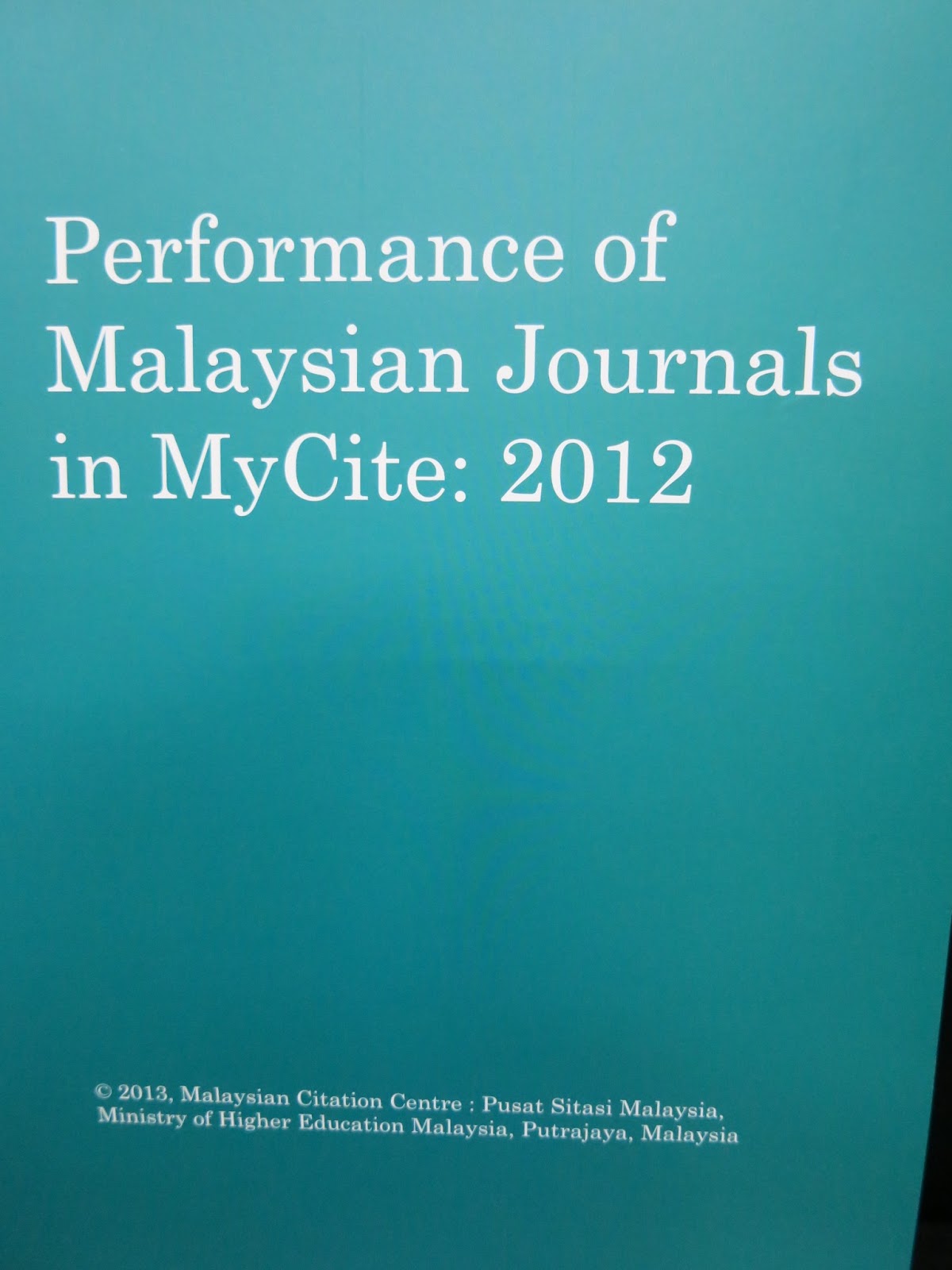
The Malaysian Citation Centre of the Ministry of Higher Education recently published its first report titled "Performance of Malaysian Journals in MyCite: 2012".  Basically, the report aims to inform about the status and performance of Malaysian journals that are currently indexed in MyCite (Malaysian Citation Index).  To date, MyCite lists a total of 112 journals, covering five main disciplines: Arts & Humanities (21), Engineering & Technology (14), Medical & Health (19), Sciences (27) and Social Sciences (31).  The majority of the journals indexed are published by the universities (75%) and the remaining by either professional societies (19%) or other government agencies (6%).  The Accounting Research Institute (ARI) showcases two journals, namely the Asia-Pacific Management Accounting Journal (APMAJ) and the Malaysian Accounting Review (MAR). MyCite basically aims to promote Malaysian journals and to encourage appropriate citations of these journals.   Broadly, a citation is a reference to a published or unpublished source (not always the original source). Citation has several important purposes: to uphold intellectual honesty, to attribute prior or unoriginal work and ideas to the correct sources, to allow the reader to determine independently whether the referenced material supports the author's argument in the claimed way, and to help the reader gauge the strength and validity of the material the author has used.  Renowned database companies such as ISI Thomson and SCOPUS normally publish Journal Citation Reports (JCR) to evaluate the level of citations received by those journals that they indexed.  As such, the higher the level of citation (often measured by the journal H-Index), the higher is the impact of those journals to the body of knowledge, hence the higher is the "quality" of those journals.  With reference to the MyCite report, only 88 journals have obtained an H-Index of at least "1".  Of these, twelve journals have between "3-6" H-Index; 27 journals with "2" H-Index and 49 with an H-Index of "1".  ARI's two journals, MAR and APMAJ  have respectively garnered "2" and "1" H-Index.  It's a great start.  What that also meant, ARI researchers must aggressively promote the journals and when appropriate, cite them accordingly.

Tuesday, January 29, 2013

Minister's New Year Message

In his recent new year message, the Minister of Higher Education (MOHE), Datuk Seri Mohamed Khaled Nordin outlined eight MOHE agendas: (1) Reviewing of the MOHE National  Strategic Plan (PSPTN); (2) Introducing MOHE Outreach Program; (3) Generating Innovation-based Economy; (4) Enhancing the quality of higher education; (5) Strengthening the marketability of graduates; (6)  Mapping of MOHE's internationalisation agenda; (7)  Education Inclusion for all and (8)  Inculcating innovative work culture.  Several.  In ensuring high quality of higher education, the Ministry has placed a moratorium on the setting up of new private institutes of higher learning (IPTS).  MOHE research agenda is further strengthened by the introduction of the online research grant management system known as "MyGrants".  The online portal would certainly facilitate research collaboration among researchers from different institutions of higher learning...

Thursday, January 24, 2013

Social Enterpreneurship


The concept of "Social Enterpreunership" was recently discussed by the Organisation for Economic Co-operation and Development (OECD) Local Economic and Employment Development Programme (LEED).  In an undated paper titled The Social Enterprise Sector: A Conceptual Framework, social enterprises can be defined as "organisations with an explicit aim to benefit the community, initiated by a group of citizens and in which the material interest of capital investors is subject to limits.  They place a high value on their independence and on economic risk-taking related to on-going socio-economic activity".  From a cross-country perspective, it is possible to identify a set of key economic and social elements that help define social enterprises across national differences:  First, Unlike traditional non-profit organisations, social enterprises are directly engaged in the production and/or sale of goods and services  (rather than predominantly advisory or grant-giving functions),  Second, social enterprises are voluntarily created and managed by groups of citizens. As a result, while they may receive grants and donations from public authorities or private companies, social enterprises enjoy a high degree of autonomy and shareholders have the right to       participate (‘voice’) and to leave the organisation (‘exit’).  Third, the financial viability of social enterprises depends on the efforts of their members, who are responsible for ensuring adequate financial resources, unlike most public institutions. Social enterprises therefore involve a significant level of economic risk; Fourth, activities carried out by social enterprises require a minimum number of paid workers, even if they may  combine voluntary and paid workers. Fifth, social enterprises are the result of an initiative by citizens involving people belonging to a community or to a group that shares a certain need or aim. They must maintain this dimension in one form or another.  Sixth, decision making rights are shared by stakeholders, generally through the principle of ‘one member, one vote’. Although capital owners in social enterprises play an important role, decision-making power is not based on capital ownership.  Seventh, social enterprises are participatory in nature, insofar as those affected by the activities (the users of social enterprises’ services) are represented and participate in the management of activities. In many cases one of the objectives is to strengthen democracy at local level through economic activity.  Eight, social enterprises include organisations that totally prohibit the distribution of profits and organisations such as co-operatives, which may distribute their profit only to a limited degree. Social enterprises therefore avoid profit maximising behaviour, as they involve a limited distribution of profit. Ninth, social enterprises pursue an explicit aim to benefit the community or a specific group of people. By doing so, they directly and indirectly promote a sense of social responsibility at local level.  

Saturday, December 15, 2012

Anti Money Laundering Course

The new cohort of the Financial Criminology Money Laundering course is fairly large with twenty one students attending the full time mode and another thirty three students taking the part time mode. Majority of the students are from the industry - both from the public and private sectors, hence implicating increased interest in the area of forensic accounting and financial criminology among students and practitioners.  From the public sector, there are students from the Auditor General office; Accountant General Office; Royal Custom & Excise; Inland Revenue Board; MACC and the Royal Malaysian Police.  From the private sector, there are students from  financial institutions, audit firms, Public Listed Companies (PLCs), Consultancy firms and private corporations.  Only a handful of them are fresh graduates. Both the Faculty of Accountancy and the Accounting Research Institute (ARI) welcome the students to this course...