(i) 406,000 companies have registered for GST as at March 2016 , (ii) GST collection for 2015 is said to have exceeded the initial target of RM 27 billion (total
amount not finalised yet due to expected refunds); (iii) RM800 million GST refunds are still pending or being processed; (iv) Customs expects
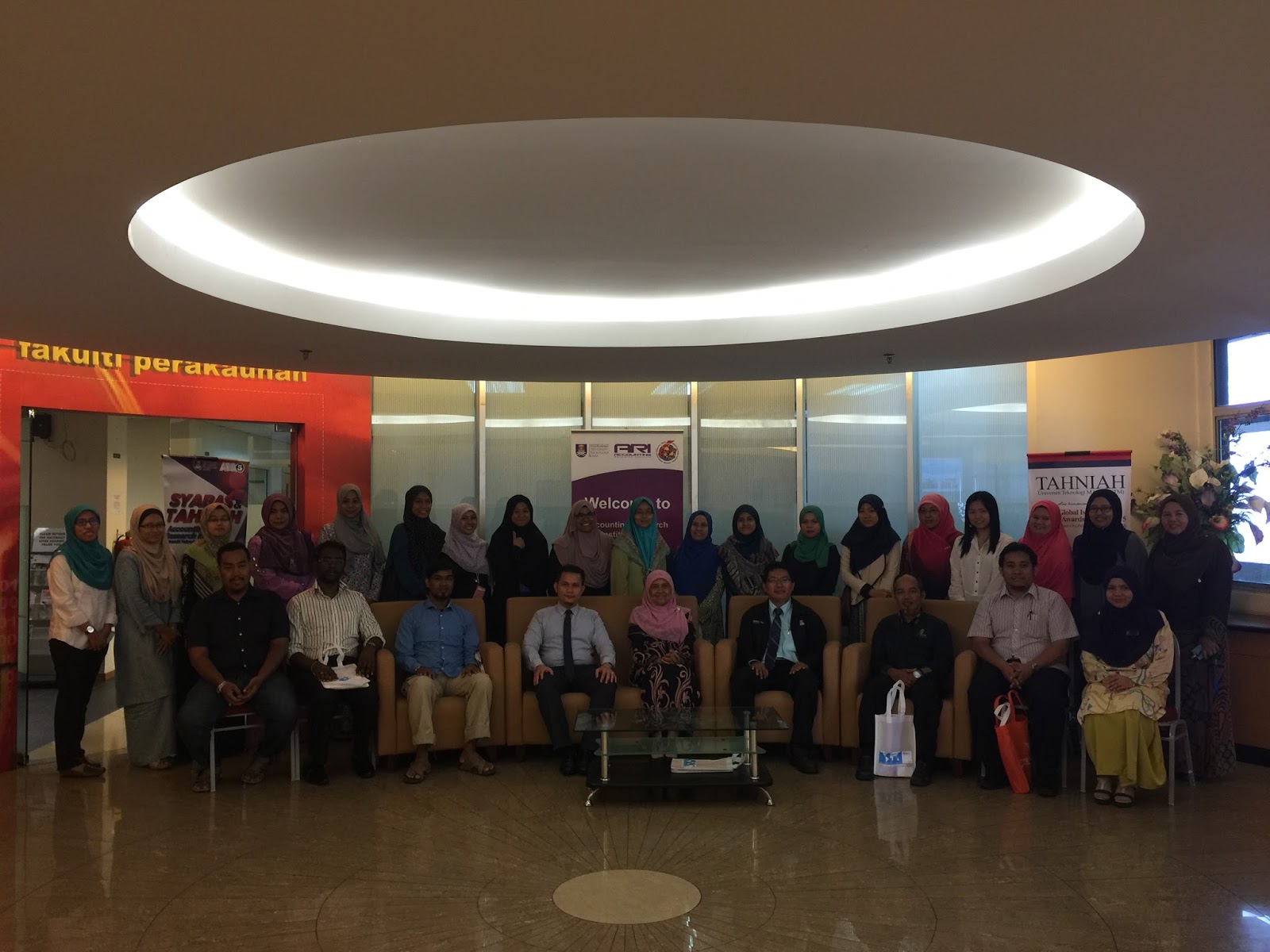
to raise RM39 billion from GST for 2016; and (v) 1,190 GST-related cases are being investigated by Customs as at 31 January 2016. In view of these interesting findings, the Accounting Research Institute (ARI) organizes a half day GST forum with the Royal Malaysian Customs (RMC), SME Corp and thirty representatives from the industries who were directly affected by the GST system. The main objectives of the forum was firstly to provide a useful platform for both regulators and practitioners to exchange ideas about GST implementation and to propose ideas for improvements. Since today's group has mainly involved SME companies, the forum also hopes to obtain first-hand feedback from manufacturing and service firms on prospects, challenges and issues related to GST Implementation by the SME industry. ARI plans to organise similar forums in all the states in Malaysia within the next three months. ARI thanks speakers Ms Annie Thomas from RMC and Mr Nik Mohd Zainul Kamarun from SME Corp.
Higher Institutions' Centre of Excellence MALAYSIA: Driving Research in Islamic Financial Criminology & WINNERS OF GLOBAL ISLAMIC FINANCE AWARDS 2014,2015, 2016 & 2017; ACQ GLOBAL AWARDS 2015 & 2016 and ASEAN Risk Management Award 2016 & 2017; Global Good Governance Awards 2017
Wednesday, April 13, 2016
ARI's Forum on GST After One Year of Its Implementation
Tuesday, April 12, 2016
Reception by the Embassy of Malaysia, Seoul
).
Monday, April 11, 2016
ARI Conference and Training in Korea
The Accounting Research Institute (ARI HICoE) in collaboration with several national (Persatuan Badan-Badan Berkanun Malaysia - PBBM) and international agencies (Institute of Public Enterprise India, Chullalongkorn University Thailand, Rikkyo University Japan and Dongguk University, Korea are organising the 3rd International Conference on Governance and Strategic Management (ICGSM) on 12-13 April 2016. With the theme "Sustainable Framework for Governance & Management Effectiveness" the conference will be held at the Dongguk University campus in Seoul, Korea. This international conference will provide an excellent opportunity for the exchange of ideas and information among researchers, academicians, practitioners and students. The conference is expected to provide meaningful findings and recent updates on the issues of strategic management and corporate governance especially those concerning risk management, accountability and integrity of the key players in the capital market.
It is essential to focus on improving innovation, strategic management and transforming institutions in order to meet the challenges of the coming decades. Governance, transparency, predictability and accountability are key elements to establishing long-term domestic legitimacy of board members and authorities. Sustaining performance can only be reached by balancing economic efficiency and reasonable profits with public interests and investment needs. The proposed conference will address the issues and challenges that the business communities are facing in terms of governance, risk management, performance management, internal control and audit mechanism, corporate integrity and transparency, competitive environment, corruption and whistle-blowing. In addition to the international conference, ARI and PBBM are also organising a field trip and site visits for statutory bodies officers to meet and discuss with their counterparts in Korea. Today, the Malaysian group was hosted by the the Malaysian Embassy officers in Seoul Korea. Tomorrow, other participants will join them for the conference.Thursday, April 7, 2016
Long Term Grant Scheme
Long term grant Scheme or LRGS is an initiative by the Ministry of Higher Education (MOHE) to support research activities of researchers in institutions of higher learning in Malaysia. Basically, LRGS is created for fundamental research that involves extensive scope and longer
duration and requires high commitment among researchers. Essentially, researches financed by LRGS are expected to generate new advance ideas and theories in the strategic niche areas (of the ministry and the government) to
expand the boundaries of knowledge. To date, there are two types of LRGS grants, namely top-down and bottom-up. The top-down scheme must be lead by a research university (RU) and focuses on eight research niche: Global Warming, Infectious Disease, Tropical Disease, Food Security, Energy & Water Security, ICT, Andanced & value Manufacturing and Societal Wellbeing. Meanwhile, bottom-up scheme can be lead by any university and may include eight (8) of the research areas
above or researchers may propose any other areas. Priorities however are given to researches that are in tandem with the country's National Priority Areas (NPA). All LRGS applications including concept papers must be reviewed and
certified by the Chair/Director of Research Management Committee
(RMC) of the University. Each sub-project applications must go through
the RMC of respective universities. Review reports must be submitted to
the Secretariat of LRGS and MOHE together with the application form.
Only applications that are supported/approved by RMC need to be sent to
MOHE. Meanwhile, MOHE appoints panel members, who in turn will review proposed concept papers. LRGS research projects must involve a variety of institutions with a minimum of 3
institutions. Projects (minimum of 3) must be multi-disciplinary, involving the corpus of
science & technology and social sciences & humanities. Minimum research output for a three-year LRGS projects are: (i) at least
10 PhD students, (ii) publication of at least 50 papers in indexed journals and (iii) 3 IPs. Recently, the first LRGS evaluation meeting for 2016 was held at MOHE.
Wednesday, March 30, 2016
ARI to Host ERASMUS Staff Mobility Program
In 2014, the Accounting Research Institute (ARI) signed a Memorandum of Understanding with Burgas Free University in Bulgaria. In 2015, Burgas Free University in collaboration with ARI and Universiti Teknologi MARA (UiTM) submitted an application for the Erasmus+ Staff Mobility for Teaching Mobility programme. Erasmus+ is the European Union (EU) programme for education, training, youth and sport. Many of the initiatives are based on opportunities for students and recent graduates, but funding is also available to help teachers, lecturers and non-academic staff develop their skills in schools, universities, colleges and adult education environments around Europe – through job shadowing, teaching and training activities. At the end of 2015, we were informed that the application was successful and three scholars from Burgas Free university will be visiting Universiti Teknologi MARA during May and June 2016. Professor Milen Baltov, Vice Rector of Research and International Cooperation, Burgas Free University will be visiting UiTM on 2nd to 7th May 2016 and his teaching assignment will be at the Arshad Ayub Graduate Business School. The Vice-Dean of the Faculty of Business Studies Prof. Lina Anastassova will be in UiTM on 29th May to 4th June and will conduct her teaching assignment at the Faculty of Hotel and Tourism Management. The third scholar, is Assoc. Prof. Tatyana Kotzeva from the Faculty of Humanities, who will visit UiTM and will be teaching at the Faculty of Communications and Media Studies on 13th to 19th June 2016. ARI will be hosting the three scholars and will be organising related programs for them. Likewise, Universiti Teknologi MARA will also be sending three scholars (two of whom will be from ARI) to Burgas Free University during the periods of May and September 2016. This is a great international collaboration for ARI and Burgas Free university.
Saturday, March 19, 2016
Research Strategic Planning
The Deputy Vice Chancellor (Research and Innovation) of Universiti Teknologi MARA, Prof Dr Abdul Rahman Omar and members of the university's Research council committee attended a one-day research workshop to discuss research strategies and performance indicators for two groups of researchers at the university: (i) members of faculties & academic centres, and (i) members of centres of excellence and community of researchers (CoRE).
Since the currently available Malaysia Research Assessment (MyRA) instrument is fairly comprehensive and detail, the workshop decided to use it as a foundation for discussions. At the end of the workshop, there were some interesting proposed strategic actions that could be undertaken by researchers. The Institute of Research Management and Innovation (IRMI) who acts as a secretariat will tabulate the discussions which will be presented in the next Research Council meeting.
Friday, March 18, 2016
Non Profit Organisations and Governance
In both industrialized and developing countries, there is a growing body of experience, which attests to the positive roles that non-profit organizations (NPOs) play in the economic development of a country. In many developed countries, NPOs have been recognized as a "third sector", after public and private sectors. These roles may include:-
- providing goods and services - especially meeting needs which have not hitherto been met by either the public or by the private sector;
- assisting the government achieve its development objectives - in particular through contributing skills for which NPOs have comparative advantage, such as public information, education and communications campaigns, or providing information about the situations and needs of particularly vulnerable groups;
- helping citizens to voice their aspirations, concerns and alternatives for consideration by policy makers, thereby giving substance to governments' policies regarding freedoms of association and speech;
- helping to enhance the accountability and transparency of government and local government programs and of officials.
Thursday, March 17, 2016
Economic Transformation Program in Terengganu
In 2012, as part of its research in Islamic Financial Criminology, the Accounting Research Institute (ARI HICoE) initiated three Islamic-based economic transformation programs: Islamic microfinance, Islamic-based social enterprise and corporate waqaf. When reviewing existing Islamic microfinance model, ARI researchers identified one very important gap - the need to link micro entrepreneurs to a complete supply chain, including both supplier(s) of reasonably-priced raw materials for the business and buyers of the business's finished products. A pilot research project was carried out in Tanjung Karang with a group of microfinance recipients from Amanah Ikthiar Malaysia (AIM) - a microcredit organisation. The entrepreneurs were involved in a tailoring business. Since their clients were mainly among locals from Tanjung Karang, the market place for the "baju kurung" business was not only limited, more unfortunately, it was also seasonal in nature. ARI researchers invited Mydin Holding Berhad to act both as a supplier of fabrics for baju kurung and as a buyer of ready-made baju kurung. ARI developed a training module where entrepreneurs were exposed to new competencies of financial management, business planning and business governance. With the much improved version of business framework, the entreprenuers were able to increase their sales, profits, capital and savings. The Tanjung Karang micro business was later replicated to two other locations in Terengganu through a tripartite collaboration of ARI (UiTM), Yayasan DiRaja Sultan Mizan (YDSM) and Mydin Holding Berhad. YDSM identified two locations - Paka and Kuala Terengganu.
Using the same framework, Mydin Holding Berhad supplies fabrics to the tailoring business entrepreneurs. and later on, buy-back the completed baju kurung for sale in Mydin Hypermarkets. To mark the successes of both the Paka and Kuala Terengganu micro-business groups, ARI organised a three-party Memorandum of Agreement between Universiti Teknologi MARA, YDSM and Mydin Holding Berhad. The Islamic microfinance programs in Tanjung Karang, Paka and Kuala Terengganu had significantly transformed the economic status of the entrepreneurs. In fact UiTM is planning to replicate the program to other states through the respective state campuses.
Wednesday, March 16, 2016
Visit to Royal Malaysian Customs on GST
With the implementation of the Goods and Services Tax (GST) in Malaysia effective 1st April 2015, there are a lot of interest among researchers to conduct studies on GST. Popular topics include GST compliant, Indirect tax evasion, GST audit and GST implementation. Today, three researchers from the Accounting Research Institute (ARI) of Universiti Teknologi MARA visited the Goods Services Tax (GST) Unit of the Royal Malaysian Customs (RMC) in Putrajaya. Basically the basic aim of the visit was to discuss with officers from RMC on ARI's ongoing research on GST and how researchers can get assistance from the department. There are a number of new PhD students who are interested to embark on GST-related topics within ARI's PhD program in Financial Criminology. In April, ARI is to organise a GST seminar titled "GST after One Year of Its Implementation". The target participants are those industry players from manufacturing companies from the Small and Medium category. In comparison to sales and service tax, GST is more comprehensive, effective, transparent and business friendly. GST should be able to overcome the various weaknesses within the previous consumption tax system. GST is expected to increase tax compliance and is easier to administer in view of its self policing method. In addition, businesses are required only to submit simplified tax returns based on prescribed formats. In fact, all records and documents relating to the relevant transaction are required to be kept in the business premises for audit by the GST auditors.
Saturday, March 5, 2016
International Research Collaboration with the Faculty of Economics, Universitas Riau (UNRI), 11-12 February 2016, Riau, Indonesia
Subscribe to:
Posts (Atom)