Wednesday, November 30, 2011
Accountability Against Financial Fraud
"Pay Up or be Axed"....That's the headline that appeared on the main page of The Star newspaper dated 26th November 2011. Basically, the headline was refering to the Malaysian government recent proposal in mitigating the issue of occupational or management fraud within the public sector. It was further stated that "Officers who cause the government to lose money due to their negligence will be made to repay a portion of the lost revenue and they may even be sacked. If there are cases of embezzlement, ministry and department heads have to take the responsibility to report the matter to the police so that an investigation can be carried out". The Public Service Department (PSD)introduced these measures to ensure that civil servants are held accountable for the losses highlighted by the Auditor General in the 2010 Report. PSD recently issued a set of comprehensive guidelines to all ministries and state authorities on procedures in managing financial fraud at workplaces...


Tuesday, November 29, 2011
Book Publication on CISM
The Malaysian Institute of Integrity (IIM) is embarking on the publication of a new book titled "Corporate Integrity System Malaysia" (CISM).  The Accounting Research Institute, which is represented by its director, Professor Dr Normah Omar has been invited to chair the "Book Publication" meeting held today at IIM. Premised on the New Economic Model (NEM) the CISM solicits feedback from various stakeholders: Professional Bodies, Trade chambers, Academia Experts, Regulatory Authorities, Enforcement Agencies, Multinational Corporations, Government-Linked Companies,
Public Listed Companies, Small Medium Industries, Retailers and Consumer Markets. In soliciting feedback from stakeholders, the Private Sector Group of IIM had organized many Roundtable sessions and seminars. The academia Expert group has successfully produced a "Consultative Document on Corporate Integrity System Assessment Questionnaire" that can be used by corporations to self-assess their corporate integrity system.
 The Accounting Research Institute, which is represented by its director, Professor Dr Normah Omar has been invited to chair the "Book Publication" meeting held today at IIM. Premised on the New Economic Model (NEM) the CISM solicits feedback from various stakeholders: Professional Bodies, Trade chambers, Academia Experts, Regulatory Authorities, Enforcement Agencies, Multinational Corporations, Government-Linked Companies,
Public Listed Companies, Small Medium Industries, Retailers and Consumer Markets. In soliciting feedback from stakeholders, the Private Sector Group of IIM had organized many Roundtable sessions and seminars. The academia Expert group has successfully produced a "Consultative Document on Corporate Integrity System Assessment Questionnaire" that can be used by corporations to self-assess their corporate integrity system.
Sunday, November 27, 2011
New Tools and Research Projects in Financial Fraud investigation
Towards the end of the semester, the students who are currently undertaking  the Anti Money Laundering and Financial Criminology course are busy finalising their final research project. The project requires the students to work in group and to choose real financial fraud cases and to simulate the cases with latest analytical techniques in fraud investigation. The simulation project requires them to come up with fresh documentary evidences by conducting face to face interviews with different groups of employees affected by the fraud or to discuss with enforcement agencies and regulators.
 . Throughout the semester, the students have been exposed to various real-life financial fraud cases. They had to present two prior cases where they had to (i) identify possible weaknesses in the internal control system; (ii) understand the theories underpinning fraudulent behaviours and (iii) learn to use new tools that can be handy and useful in financial fraud investigation. Three guest speakers comprising a police officer, a merchant banker and a deputy public prosecutor were also invited to give talks on financial criminology.
 the Anti Money Laundering and Financial Criminology course are busy finalising their final research project. The project requires the students to work in group and to choose real financial fraud cases and to simulate the cases with latest analytical techniques in fraud investigation. The simulation project requires them to come up with fresh documentary evidences by conducting face to face interviews with different groups of employees affected by the fraud or to discuss with enforcement agencies and regulators.
 . Throughout the semester, the students have been exposed to various real-life financial fraud cases. They had to present two prior cases where they had to (i) identify possible weaknesses in the internal control system; (ii) understand the theories underpinning fraudulent behaviours and (iii) learn to use new tools that can be handy and useful in financial fraud investigation. Three guest speakers comprising a police officer, a merchant banker and a deputy public prosecutor were also invited to give talks on financial criminology.
Saturday, November 26, 2011
Forensic Accounting and Financial Criminology Association
The Protem Committee and graduates of our Master in Forensic Accounting and Financial Criminology Program met up today to discuss the formation of the Forensic Accounting and Financial Criminology Association and the registration of the association with the Registrar of Societies (ROS).  Members of the association will comprise graduates of the program whose number is now reaching two hundred. The Master program was first introduced in July 2006 and the first graduate cohort was produced in August 2008. In addition to normal membership, the association will also admit students and practioners as associate members. Currently, the top three protem committee members comprise President, Mohd Rashid Tan Sri Musa; Haswadi (Deputy President) and Hesri Faizal (Secretary). The formation of the association will path the way towards developing more qualified professionals in the area of forensic accounting and financial criminology. As a HICoE driving a niche research area of Islamic Financial Criminology, the formation of this new association will certainly adds value to the Accounting Research Institute (ARI)and the Faculty of Accountancy, Universiti Teknologi MARA (UiTM). More collaborative works in the area of research, training program and publications will be initiated with the upcoming association.
 Members of the association will comprise graduates of the program whose number is now reaching two hundred. The Master program was first introduced in July 2006 and the first graduate cohort was produced in August 2008. In addition to normal membership, the association will also admit students and practioners as associate members. Currently, the top three protem committee members comprise President, Mohd Rashid Tan Sri Musa; Haswadi (Deputy President) and Hesri Faizal (Secretary). The formation of the association will path the way towards developing more qualified professionals in the area of forensic accounting and financial criminology. As a HICoE driving a niche research area of Islamic Financial Criminology, the formation of this new association will certainly adds value to the Accounting Research Institute (ARI)and the Faculty of Accountancy, Universiti Teknologi MARA (UiTM). More collaborative works in the area of research, training program and publications will be initiated with the upcoming association.
Friday, November 25, 2011
Discussions on Islamic Microfinancing
The Islamic Accounting and Muamalat research group had a fruitful discussion with one of the guest speakers of the World Universities 1st Zakat Conference which was just recently held in Kuala Lumpur. 
The speaker, Dr Malik Al Asmar (in brown suit)from Belgium visited the Accounting Research Institute this morning to discuss on possible international collaboration in zakat research and Islamic microfinancing. Both topics are in line with ARI's 2012 research program in Islamic Accounting and Muamalat. Dr Malik has agreed in principle to participate with ARI for both projects. A phd student from Iran, Mr Syed (in brown shirt)has recently enrolled with ARI to embark on a study related to Islamic Microfinancing.

The speaker, Dr Malik Al Asmar (in brown suit)from Belgium visited the Accounting Research Institute this morning to discuss on possible international collaboration in zakat research and Islamic microfinancing. Both topics are in line with ARI's 2012 research program in Islamic Accounting and Muamalat. Dr Malik has agreed in principle to participate with ARI for both projects. A phd student from Iran, Mr Syed (in brown shirt)has recently enrolled with ARI to embark on a study related to Islamic Microfinancing.
Thursday, November 24, 2011
ARI Exhibition at a "211 Hours Non-Stop Debate"
In an effort to list this activity in the Malaysia Book of Records,  the organizers comprising Universiti Teknologi MARA, Utusan Malaysia and Majlis Belia Malaysia (MBM) organize a "211 hours non-stop debate". Themed "Transformation and National Integration", the debate's participants include students from public universities, private universities, community colleges, Teachers colleges, polytechnics and secondary schools in Malaysia. At the end of the event, the organizers expect to produce useful resolutions as proposed by the Generation Y.
  Yang Berhormat Dato' Saifuddin Abdullah, Deputy Minister of the Ministry of Higher Education graced open to officiate the event today at Universiti Teknologi MARA. In conjunction with the historic eight-day event, the Accounting Research Institute (ARI) participates in the exhibition activity by showcasing ARI's research products and expertise. As a Higher Institutions' Centre of Excellence (HICoE), ARI's expertise cover varied range of accounting-related matters. This include financial criminology, forensic accounting, Islamic accounting
  & finance, public sector accounting, corporate governance, CSR reporting & sustainability, Financial Reporting, accounting standards, government-link companies research and management accounting. All the best to all. The time clicks on, time to beat... 211 hours
 the organizers comprising Universiti Teknologi MARA, Utusan Malaysia and Majlis Belia Malaysia (MBM) organize a "211 hours non-stop debate". Themed "Transformation and National Integration", the debate's participants include students from public universities, private universities, community colleges, Teachers colleges, polytechnics and secondary schools in Malaysia. At the end of the event, the organizers expect to produce useful resolutions as proposed by the Generation Y.
  Yang Berhormat Dato' Saifuddin Abdullah, Deputy Minister of the Ministry of Higher Education graced open to officiate the event today at Universiti Teknologi MARA. In conjunction with the historic eight-day event, the Accounting Research Institute (ARI) participates in the exhibition activity by showcasing ARI's research products and expertise. As a Higher Institutions' Centre of Excellence (HICoE), ARI's expertise cover varied range of accounting-related matters. This include financial criminology, forensic accounting, Islamic accounting
  & finance, public sector accounting, corporate governance, CSR reporting & sustainability, Financial Reporting, accounting standards, government-link companies research and management accounting. All the best to all. The time clicks on, time to beat... 211 hours
Wednesday, November 23, 2011
Preparing for PhD Research Proposal
This week, aspiring PhD candidates of the university are attending an intensive research proposal workshop which is organized by the Institute of Leadership and Quality Managemenet (IlQAM).  As one of the facilitators for the workshop, Prof Dr Normah Omar, Director of the Accounting Research Institute (ARI) delivered her talk today on a topic "Preparing a PhD Research Proposal". It was stressed in her talk that one of the most important elements of a research prosal is the identification of the right "PROBLEM STATEMENT". It is important in a proposal that the problem stand out so that the reader can easily recognize it. Sometimes, obscure and poorly formulated problems are masked in an extended discussion.
  In such cases, reviewers and/or committee members will have difficulty recognizing the problem. A problem statement should be presented within a context, and that context should be provided and briefly explained, including a discussion of the conceptual or theoretical framework in which it is embedded. Clearly and succinctly identify and explain the problem within the framework of the theory or line of inquiry that undergirds the study. This is of major importance in nearly all proposals and requires careful attention. It is a key element that associations such as AERA and APA look for in proposals.
  It is essential in all quantitative research and much qualitative research. State the problem in terms intelligible to someone who is generally sophisticated but who is relatively uninformed in the area of your investigation. Effective problem statements answer the question “Why does this research need to be conducted.” If a researcher is unable to answer this question clearly and succinctly, and without resorting to hyperspeaking (i.e., focusing on problems of macro or global proportions that certainly will not be informed or alleviated by the study), then the statement of the problem will come off as ambiguous and diffuse. Once the problem is clearly identified, pay attention to other important components of a proposal:
1. Title (Working Title)
2. Preamble/Introduction
3. Short Statement of the Problem
4. Research Objectives
5. Research Questions/Hypothesis
6. Review of Research Literature
7. The Design - Methods and Procedures
8. Tentative Time Table
9. References
10.Attachments/Appendixes
 As one of the facilitators for the workshop, Prof Dr Normah Omar, Director of the Accounting Research Institute (ARI) delivered her talk today on a topic "Preparing a PhD Research Proposal". It was stressed in her talk that one of the most important elements of a research prosal is the identification of the right "PROBLEM STATEMENT". It is important in a proposal that the problem stand out so that the reader can easily recognize it. Sometimes, obscure and poorly formulated problems are masked in an extended discussion.
  In such cases, reviewers and/or committee members will have difficulty recognizing the problem. A problem statement should be presented within a context, and that context should be provided and briefly explained, including a discussion of the conceptual or theoretical framework in which it is embedded. Clearly and succinctly identify and explain the problem within the framework of the theory or line of inquiry that undergirds the study. This is of major importance in nearly all proposals and requires careful attention. It is a key element that associations such as AERA and APA look for in proposals.
  It is essential in all quantitative research and much qualitative research. State the problem in terms intelligible to someone who is generally sophisticated but who is relatively uninformed in the area of your investigation. Effective problem statements answer the question “Why does this research need to be conducted.” If a researcher is unable to answer this question clearly and succinctly, and without resorting to hyperspeaking (i.e., focusing on problems of macro or global proportions that certainly will not be informed or alleviated by the study), then the statement of the problem will come off as ambiguous and diffuse. Once the problem is clearly identified, pay attention to other important components of a proposal:
1. Title (Working Title)
2. Preamble/Introduction
3. Short Statement of the Problem
4. Research Objectives
5. Research Questions/Hypothesis
6. Review of Research Literature
7. The Design - Methods and Procedures
8. Tentative Time Table
9. References
10.Attachments/Appendixes
NPO Governance & Reporting
The Selangor Registrar of Societies (ROS)is embarking on a pilot project to enhance the 
governance and reporting of societies and non profit organisations (NPO) who are currently registered with ROS. The pilot project is initiated jointly by ROS and the Accounting Research Institute (ARI) of Universiti Teknologi MARA. Premised on the requirements of the Societies Act 1966, the Asia Pacific Group on anti Money Laudering (APG Mutual Evaluation 2007) Report and the APG Typologies of NPO (2011), the pilot project develops an assessment instrument and evaluates the governance and financial reporting practices of 100 NPOs. The results of the pilot project will be ready by the end of November 2011. Today, Prof Dr Normah Omar (ARI Director), associate Professor Dr Roshayani Arshad (Head of the project) met up with ROS directors from Selangor (MR Noreffendy) and Kuala Lumpuar (Ms Zuliana) to discuss research progress. Currently ROS Selangor and ROS Kuala Lumpur have respectively more 9,000 and 8,000 societies and NPOs registered under them. Efforts are continuously undertaken by ROS to improve the governance and financial reporting of NPOs in Malaysia.

governance and reporting of societies and non profit organisations (NPO) who are currently registered with ROS. The pilot project is initiated jointly by ROS and the Accounting Research Institute (ARI) of Universiti Teknologi MARA. Premised on the requirements of the Societies Act 1966, the Asia Pacific Group on anti Money Laudering (APG Mutual Evaluation 2007) Report and the APG Typologies of NPO (2011), the pilot project develops an assessment instrument and evaluates the governance and financial reporting practices of 100 NPOs.
 The results of the pilot project will be ready by the end of November 2011. Today, Prof Dr Normah Omar (ARI Director), associate Professor Dr Roshayani Arshad (Head of the project) met up with ROS directors from Selangor (MR Noreffendy) and Kuala Lumpuar (Ms Zuliana) to discuss research progress. Currently ROS Selangor and ROS Kuala Lumpur have respectively more 9,000 and 8,000 societies and NPOs registered under them. Efforts are continuously undertaken by ROS to improve the governance and financial reporting of NPOs in Malaysia.
Monday, November 21, 2011
Financial Fraud Investigation Analysis
Master students from the Anti Money Laundering 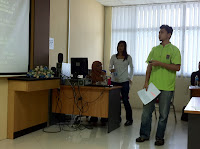 and Financial Criminology course presented their respective local financial fraud cases and showcased different analytical techniques which include Beniesh M-Score Model, Horizontal & Analytical Analysis, Ratio Analaysia. Fraud Risk Indicator Typology, Risk Management Model, Financial Integrity model, Accounting Anamolies Analysis. Some of the local cases presented include Transmile Berhad, Megan Media Berhad, Nasioncom, Tat Sang Berhad, Jasatera Bhd,
  Wimems Corporation Bhd, Welli Multi Corporation and Inix Group. One of the groups was presenting two cases of cheque fraud and how the use of the VSC6000 document analyzer machine was able to detect the fraud. The focus of the presentation was to highlight financial fraud investigation framework as well as analysis of the data collected. Most of the companies who were involved with financial reporting-related issues have since either been suspended or delisted from the local bourse.
 and Financial Criminology course presented their respective local financial fraud cases and showcased different analytical techniques which include Beniesh M-Score Model, Horizontal & Analytical Analysis, Ratio Analaysia. Fraud Risk Indicator Typology, Risk Management Model, Financial Integrity model, Accounting Anamolies Analysis. Some of the local cases presented include Transmile Berhad, Megan Media Berhad, Nasioncom, Tat Sang Berhad, Jasatera Bhd,
  Wimems Corporation Bhd, Welli Multi Corporation and Inix Group. One of the groups was presenting two cases of cheque fraud and how the use of the VSC6000 document analyzer machine was able to detect the fraud. The focus of the presentation was to highlight financial fraud investigation framework as well as analysis of the data collected. Most of the companies who were involved with financial reporting-related issues have since either been suspended or delisted from the local bourse.
Saturday, November 19, 2011
APMAA Conference 2011 - Day Three
Day three started with three parallel sessions which were grouped under Finance, Audit & Financial Reporting and Management Accounting- Budget & Reward System. A total of nine papers were presented in the early morning sessions. After the morning break, another twelve papers were elaborated and discussed in three sub-groups of "performance evaluation", "Balanced Scorecard" and "intellectual Capital & Information Technology". The final session of the conference was the Plenary Discussions. The Plenary segment was moderated by Professor Akira Nishimura, the founder and first president of the Asia Pacific Management Accounting Association (APMAA).
 Two speakers namely Prof Paul Scarborough from Brock University, Canada and Prof Kenji Yasukata from Kinki University Japan presented their papers which looked at the role of management accounting information in value creation in international companies. Prior to the closing of the conference, APMAA President Professor Susumo Ueno made his closing speech and remark. In a nutshell APMAA Conference 2011 has achieved its objectives. In the afternoon, private meetings were held by members of the steering committee
and the Asia Pacific Management Accounting Journal APMAJ. Discussions were also made on forging international research collaboration among APMAA member countries and for members to secure international grants for the projects. The Accounting Research Institute (ARI) from Malaysia is initiating a one year research project on "Target Costing Implementation and Practices in Asia Pacific Region". To date, members from several countries have indicated interest to participate: Japan, China, Taiwan, Korea, Singapore, Australia, New Zealand, Canada, UAE, Indonesia and Bangladesh. The group hopes to present their survey findings during the next APMAA Conference. Another collaborative project is a managemenmt accounting book with the proposed title of "Management Accounting Practices in the Asia Pacific Region" which is also targeted to be completed within a year. Professor Roger Willet and Professor Nishimura will be joint editors for this book. Till we meet again next year at the 8th APMAA Conference in Xiamen, China.
 A total of nine papers were presented in the early morning sessions. After the morning break, another twelve papers were elaborated and discussed in three sub-groups of "performance evaluation", "Balanced Scorecard" and "intellectual Capital & Information Technology". The final session of the conference was the Plenary Discussions. The Plenary segment was moderated by Professor Akira Nishimura, the founder and first president of the Asia Pacific Management Accounting Association (APMAA).
 Two speakers namely Prof Paul Scarborough from Brock University, Canada and Prof Kenji Yasukata from Kinki University Japan presented their papers which looked at the role of management accounting information in value creation in international companies. Prior to the closing of the conference, APMAA President Professor Susumo Ueno made his closing speech and remark. In a nutshell APMAA Conference 2011 has achieved its objectives. In the afternoon, private meetings were held by members of the steering committee
and the Asia Pacific Management Accounting Journal APMAJ. Discussions were also made on forging international research collaboration among APMAA member countries and for members to secure international grants for the projects. The Accounting Research Institute (ARI) from Malaysia is initiating a one year research project on "Target Costing Implementation and Practices in Asia Pacific Region". To date, members from several countries have indicated interest to participate:
 Japan, China, Taiwan, Korea, Singapore, Australia, New Zealand, Canada, UAE, Indonesia and Bangladesh. The group hopes to present their survey findings during the next APMAA Conference. Another collaborative project is a managemenmt accounting book with the proposed title of "Management Accounting Practices in the Asia Pacific Region" which is also targeted to be completed within a year. Professor Roger Willet and Professor Nishimura will be joint editors for this book. Till we meet again next year at the 8th APMAA Conference in Xiamen, China.
Subscribe to:
Posts (Atom)